The 1995 top landing: fifteen years of success, then a crash
Key idea
Some 1,500 successful top landings proved nothing: the one that failed was flown perfectly, so the error was the decision to land there at all, every time.
Read first: this case draws on Warning signs, suppressed, in Factor II · Murphy’s Corollary.
In July 1995 Mike Meier was flying production test flights on hang gliders for Wills Wing. To save the long drive back up the mountain, the crew thermalled up after each test and landed on top, near where they had launched. Mike had made that landing about a hundred times a year for fifteen years. Then one day he lost control of the glider in a strong piece of turbulence just before the landing flare, and crashed hard.
Background: why land on top
Production test flying is the final quality-control check for a manufacturing process that is part science and engineering and part art and craftsmanship. The normal procedure was to launch from the top of the mountain, conduct the test, land in the valley below, then drive back up for the next round, as many as eight times a day.
Profit margins in hang gliding are thin. About fifteen years before Mike’s accident, the crew hit on a way to save time: thermal up from launch, fly the test, and land back on top. It saved the drive back up, and it saved one crew member, the driver who would otherwise take the truck down to collect them after each round.
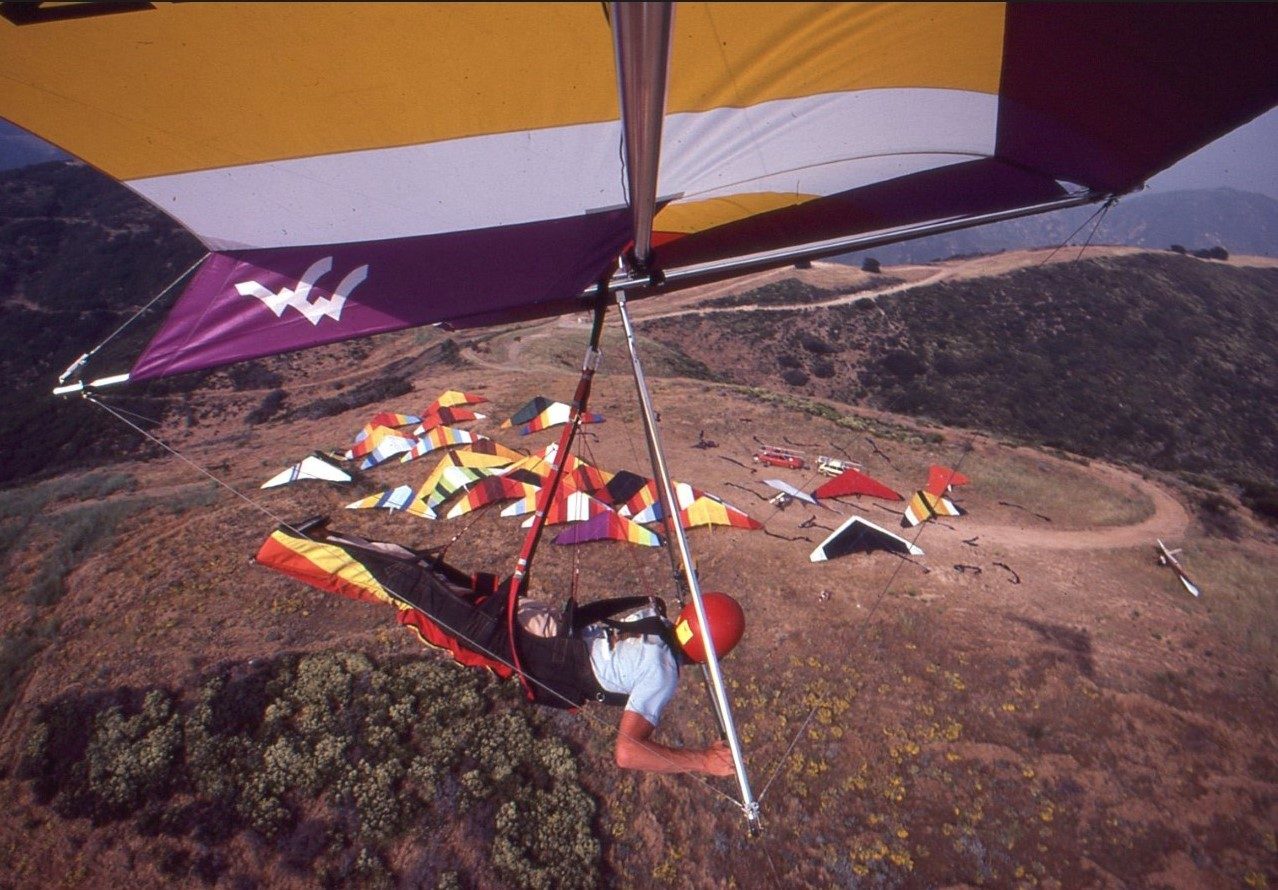
The approach
Not every launch site lends itself to top landing, but one of theirs did. Still, it demanded precision. Approach into the wind and there are two likely outcomes: too high or too fast and you overshoot, or too low or too slow and you descend into the rotor behind the hill and lose control in the turbulence. The window of “just right” between the two is extremely small.
So the crew developed an alternative: come in half crosswind, more from the side of the hill than from the back, with good speed, and land on the upslope slightly below the top. Approaching fast kept control authority through the turbulence; landing on the upslope cut the time spent slow.
What happened
They did this for more than fifteen years whenever conditions allowed, and in that time Mike made probably fifteen hundred or more successful landings. Then one day he lost control of the glider in a strong piece of turbulence just before the landing flare, and crashed hard.
For a brief moment after impact I thought I might be dead. For a moment longer, I thought I might be paralyzed.
In the end he got away with a sprained ankle and a moderate case of whiplash.
Looking for the error
The accident came just before a family trip to East Africa, which gave him three weeks to think about it. He went over every aspect of the approach. The glider was an intermediate model, not very demanding. The conditions were typical summer thermals, not particularly strong. He had done hundreds of landings in stronger conditions on more demanding gliders, and he had flown that approach exactly as he intended.
Finding no mistake in the execution left one conclusion: the landing attempt had been inherently, significantly dangerous. The error was the decision to attempt it.
And given that most of the top landings I had done over the previous fifteen years had involved gliders and conditions that were as demanding or more demanding, that meant that every one of those other decisions had also been bad decisions.
They had been bad decisions in spite of the fact that no bad outcome had followed any of them.
The crew did not stop landing on top at once, but they stopped not long afterwards.
Which factors it shows
- I · Deceptive mathematics
- Fifteen hundred successes felt like proof. But a small risk on each landing, repeated that many times, made a bad outcome likely sooner or later.
- II · Murphy’s Corollary
- Each safe landing quieted the thought “this may not end well.” Other pilots’ crashes were put down to poor technique. See Warning signs, suppressed.
- III · The pressure to go
- The technique existed to save time and a crew member. Every successful top landing saved time and money, which made the next one easier to choose.
Questions for discussion
- Which routine operation in your program has a long record of success but has never been measured against a safety margin?
- When did you last think “this may not end well” during an operation, and “what could go wrong?” after it?
- What quantitative metric and target would tell you that a successful outcome was really luck?
- What does the routine save you in time, money or crew, and how does that saving shape the go decision?
- When someone else has a mishap doing what you do, how do you decide whether it was their technique or the operation itself?
These questions also appear, with every other case’s, in the Briefing Kit.
Cite this page
Meier, M. (2026, November 10). The 1995 top landing: Fifteen years of success, then a crash (Edition 1.0). meiersafe.com. https://meiersafe.com/case-studies/top-landing-1995/
Chicago and BibTeX
Meier, Mike. “The 1995 Top Landing: Fifteen Years of Success, Then a Crash.” Edition 1.0. meiersafe.com, November 10, 2026. https://meiersafe.com/case-studies/top-landing-1995/.
@misc{meier2026toplanding1995,
  author = {Meier, Mike},
  title  = {The 1995 Top Landing: Fifteen Years of Success, Then a Crash},
  year   = {2026},
  note   = {Edition 1.0},
  url    = {https://meiersafe.com/case-studies/top-landing-1995/}
}
The 1995 top landing by Mike Meier, meiersafe.com/case-studies/top-landing-1995/, CC BY-SA 4.0. Rob Kells’s photo is not Mike’s and falls outside this license.